Workforce capability for engineering leaders
Your team ships prototypes. We help them ship production-grade software.
Your developers build working AI-built products fast, then hit a capability gap at production — fragile auth, no environment separation, missing tests, and a codebase only one person understands. vygo's senior engineers rebuild the foundation and hand your team a codebase they can own, so the team's capability lifts with the product.
- Senior-only delivery and a fixed price after a two-week audit — not open-ended consulting.
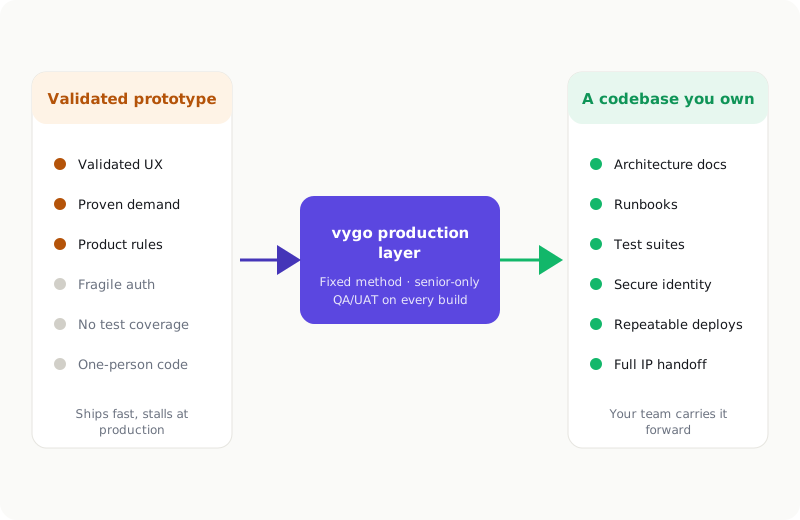
- A codebase your team can own: architecture docs, runbooks, tests, and full IP handoff.
- Independent QA & UAT on every build — verification separate from the engineers who wrote the code.
Keep the product, rebuild the foundation
vygo preserves the validated product your users rely on and re-engineers the secure, scalable foundation beneath it — then hands off full IP.
The capability gap
Fast prototypes, then a wall at production
A prototype proves demand quickly. When real users, sensitive data, enterprise buyers, and operational pressure arrive, the engineering requirements change — and a team that ships fast can stall carrying the product the rest of the way. That is not a product failure; it is the next stage of engineering.
“Only one person understands the code.”
Key-person risk caps the whole team. Tests, documentation, clean boundaries, repeatable deployments, and runbooks are what let a team carry the product forward without losing what made it valuable.
Fragile foundations under real load
Auto-generated monoliths without clear contracts, fragile auth and missing authorization, one-click infrastructure with no environment separation, and absent test coverage break when real customers arrive.
A security questionnaire is blocking the deal
The buyer already wants the product. Missing controls, evidence, logging, and an access model stall the review — and the team has no clear path to move it forward.
Builders stuck firefighting instead of building
Console-log debugging and missing incident response keep senior builders maintaining fragile systems instead of shipping. The capability gap caps both product outcomes and the team's growth.
The angle
The production layer AI tools do not provide by themselves
vygo closes the gap between a working prototype and production-grade software. Senior engineers build in the production layer AI builders skip — and the work leaves your team more capable, not more dependent.
Production engineering
Typed services, versioned APIs, reliable background jobs, automated tests, code review, CI/CD, and maintainable architecture — the foundation a team can extend.
Security by design
Threat modeling, secure defaults, SAST and dependency scanning, secrets management, least privilege, and remediation before launch — not bolted on after.
Identity and access
SSO and SAML where required, MFA, role-based access control, tenant isolation, service-account discipline, and full audit trails.
Scale and reliability
Infrastructure as code, separate environments, autoscaling strategy, performance testing, observability, SLOs, backups, and disaster-recovery planning.
How the work runs
A fixed methodology, not open-ended consulting
The validated product stays visible throughout the rebuild — weekly demos and staging access rather than waiting months for a reveal. The audit defines the scope and a fixed price before the build begins, and nothing goes live without independent QA sign-off.
Audit
A two-week review of code, architecture, security, scalability, and compliance-readiness gaps. You receive a prioritized findings report, a keep-versus-rebuild map, and a fixed-price plan — yours to keep either way.
Architect
Define the target platform without erasing validated product behavior: target architecture and data model, environment and delivery pipeline, and the security and compliance-readiness roadmap.
Rebuild
Re-engineer core services while preserving the validated UX and workflows, with weekly demos and staging access so the product stays visible the whole way.
QA & UAT on every build
Every engagement includes a dedicated QA & UAT Lead — separate from the engineers writing the code — so the people checking the work are never the people who built it. Nothing goes live without independent QA sign-off.
Harden
Prove the platform survives real load, failure, and operational use: security, load, backup and recovery testing, observability and alerting, and operational control implementation.
Own
Handoff of the complete product, source code, and infrastructure with architecture documentation, runbooks, and a full walkthrough — full IP, no lock-in, so your team carries it forward.
The outcome
A codebase your team can own
The prototype your team built is the head start, not something to erase. vygo keeps the validated work and re-engineers the rest, then hands the whole thing over — so the workforce's capability lifts with the product.
The work you already did is the head start
vygo keeps the validated UX, user-approved workflows, product rules and domain knowledge, and useful data migrated safely — the audit maps what to keep, harden, or rebuild.
Documentation your team can extend
Architecture documentation, runbooks, test suites, and deployment instructions ship with the build, so another qualified engineer — or your own team — can take it forward.
Full IP handoff, no lock-in
You receive the complete product, source code, and infrastructure. The client owns the code, infrastructure, documentation, and IP produced for the engagement.
Accountability after launch
The same team that rebuilt the product can stay accountable for uptime, security, and compliance-readiness evidence — everything stays documented so another qualified team could take over.
Why it holds up
How the engagement is built to be verifiable
The proof here is the method and the approved assurances themselves, drawn from vygo's live content. No delivery-speed claims, success rates, retention numbers, or capability-uplift metrics are stated — none exist.
Senior-only delivery
Senior people on the work — no junior bench learning on your product.
Fixed price after audit
The two-week Production Readiness Audit defines the scope and a fixed price before the build begins, so the engagement is a defined project, not open-ended consulting.
Independent QA & UAT on every build
A dedicated QA & UAT Lead, separate from the engineers, runs functional and user-acceptance testing before launch on every engagement. You approve what ships; vygo verifies it works.
Compatible with how your team builds
vygo can assess products created with tools like Lovable, Cursor, Replit, Bolt, and v0. These tool names describe compatibility, not formal partnerships or endorsement.
Before you apply
Questions engineering leaders ask
Will you throw away what we built?
No. The validated UX, workflows, product decisions, and useful data are the starting point. The audit identifies what can remain, what must be hardened, and what should be rebuilt.
Is this open-ended consulting?
No. It is a fixed methodology with a fixed price set after a two-week Production Readiness Audit, so the scope and cost are defined before the build begins.
Who tests the software before launch?
Every engagement includes a dedicated QA & UAT Lead who verifies the software — separate from the engineers writing the code — and runs functional and user-acceptance testing before launch. Nothing goes live without independent QA sign-off.
Do we get locked in?
No. You receive full IP handoff — the complete product, source code, infrastructure, documentation, and runbooks — so another qualified team could take over. There is no lock-in.
Can you guarantee SOC 2 certification?
No responsible firm can guarantee an independent auditor's decision. vygo implements the technical and operational controls, evidence workflows, policies, testing, and audit support needed to pursue SOC 2 readiness — readiness work, not a certification guarantee.
Apply for the next opening
Bring in senior engineering to close the capability gap
Tell us what your team built, where it is getting stuck, and what deadline matters. vygo reviews applications against the next available Production Readiness Audit and engineering opening. Submitting this application does not create a client relationship; work begins only under a signed agreement.
Application form
Step 1 of 2 — About you and the product
Close the prototype-to-production gap
Turn a prototype team into a production team
Senior engineers rebuild the foundation and hand your team a codebase they can own — architecture docs, runbooks, tests, and full IP. Apply for the next opening.